
ADHD and gender
Before treatment, it helps to know that ADHD does not present the same way in everyone. Hyperactivity tends to be more pronounced in people born male, showing up as restlessness and impulsivity.

People born female often show less of that, and more difficulty with inattention and executive function: planning, organising, keeping track of time.
Because those symptoms are quieter, ADHD is easily missed or misdiagnosed in women. That can mean years of untreated ADHD, and the toll it takes on self-esteem, relationships, and career shows up long before anyone names the cause.
Medication is a tool, not a cure
Stimulants like methylphenidate and amphetamines are commonly prescribed, and for many adults they genuinely help with focus and impulsivity. Omega 3s have also shown some effect on symptoms.
Medication does not address the executive function deficits underneath ADHD. Some people need a higher dose over time to get the same effect, because a dose is not a coping strategy. Others do not respond well, or the side effects make it unsuitable.
That is the case for a holistic plan. Medication can make a more manageable starting point, and the skills are what make it hold.
Learning skills to manage the traits
Treatment that lasts is built on daily skills. Cognitive behavioural therapy is the best evidenced therapeutic route here: goal-oriented, practical, and aimed at the thought patterns and behaviours that keep repeating.

Through CBT you work on procrastination, overwhelm, self-limiting beliefs, emotion regulation, and low self-esteem. These are skills, which means they respond to practice.
The power of CBT, and the ABCDE method
CBT builds awareness of the internal chatter, and its structure suits ADHD well. Here is the technique we use most, walked through with one ordinary example: a deadline at work.
Activating event
Recognise the events that trigger a specific emotion or reaction. A deadline at work lands, and the feeling that arrives with it is overwhelm.
Practised over time, this is how a more accurate read of a situation replaces the automatic one. Better self-management follows from that, not from trying harder.
Executive function coaching
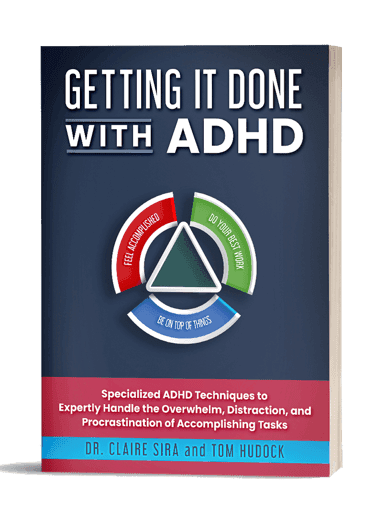
Executive function coaching is personalised work on the specific processes ADHD makes unreliable: time management, planning, organisation, and setting and reaching goals.

A coach helps you find the actual points of failure and build around them. Recognising the risky times and triggers for impulsive decisions so you can put something in place first. Breaking tasks into smaller steps. Reminders and timers. Routines that hold.
The value is in how specific it gets. Sessions are built around your needs and your strengths, which is why progress is faster than general advice.
See the Getting It Done program →Self regulation coaching
Self regulation means noticing an emotion, an impulse, or a reaction, then choosing the response rather than riding it. Emotional dysregulation is often the hardest part of adult ADHD, and it lands on relationships and decisions first.

A coach helps you identify the triggers and put strategies in place: mindfulness practice, breathing exercises, cognitive restructuring. Better regulation means less stress and less impulsivity, which shows up as steadier interactions and better focus.
When mindfulness is too much
Mindfulness builds attentional control, which reduces stress and distractibility and helps with emotion regulation. The research supports it.
If seated meditation is not where you are, mindful movement does the same job. Yoga or tai chi pair physical activity with the same principles, and body awareness and focus come along with it.

Mindfulness works best next to the other approaches, not instead of them. It is what makes distraction easier to notice before it takes the whole afternoon.
Combining approaches
There is no one-size-fits-all treatment for adult ADHD. The best results usually come from a combination: medication, CBT, executive function coaching, and self regulation coaching, in whatever mix fits your life.

A community matters more than people expect. A moderated group of adults with ADHD gives you a place to compare notes with people who already understand the problem.
Treating ADHD is not about erasing or fixing who you are. It is about finding the strategies that let you work well in a world that was not built for how you think.
Seven things worth remembering
ADHD is not a failure of character. It is a feature of how your brain works, and there is no single right way to treat it.